
Why does my jaw click when I eat - and should you be worried?
That pop, snap, or crackle when you bite into an apple might be startling — but it's usually your jaw telling you something completely harmless. Here's how to tell the difference.
You sit down to eat lunch. You take your first bite. And — click. Maybe it's been happening for years. Maybe it started last week and suddenly you're three health forum tabs deep, convinced something is very wrong. Let's cut through the noise right now.
The short answer: jaw clicking on its own, without pain, is almost always normal and rarely needs treatment. The longer answer is a bit more nuanced — and knowing the distinction could save you a lot of unnecessary worry (or, occasionally, prompt you to get the care you actually need).
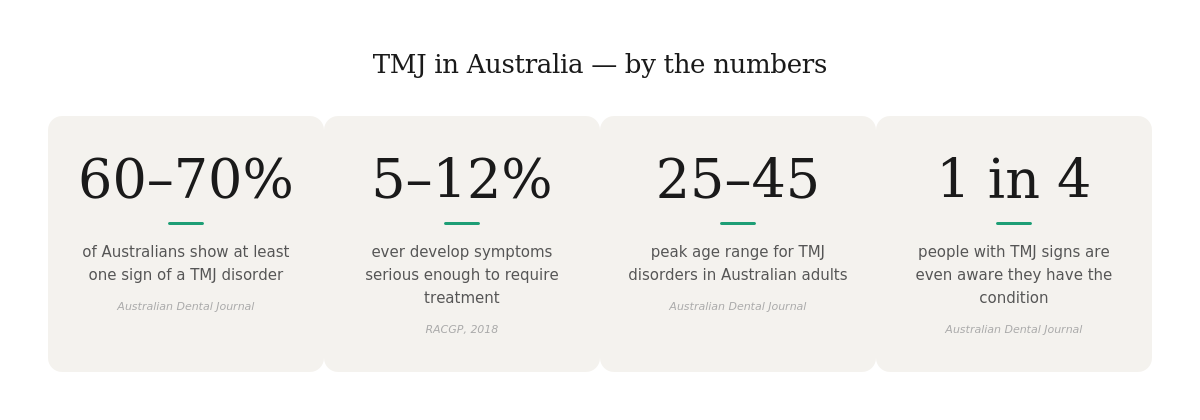
Those numbers tell an important story: jaw signs and sounds are extraordinarily common in Australia, but the vast majority of people who have them never need any treatment at all. The click is almost never the problem — it's what comes with the click that matters.
What is your jaw actually doing?
Your jaw joint — the temporomandibular joint, or TMJ - is one of the most mechanically complex joints in the body. It functions as both a hinge and a gliding joint simultaneously and it's active hundreds of times a day through chewing, swallowing, talking, and yawning.
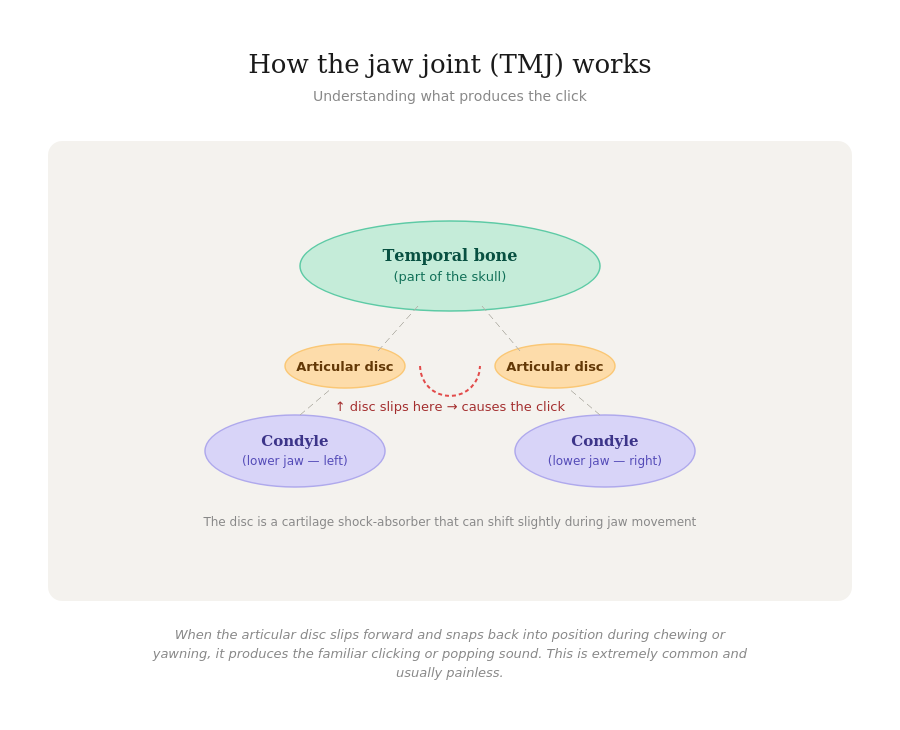
Sandwiched between the skull and the lower jaw is a small cartilage disc - think of it as a shock absorber. When this disc shifts slightly out of position and snaps back during movement, you get the familiar click or pop. As osteopaths, we assess this in the context of the whole musculoskeletal system - the jaw doesn't operate in isolation from the neck, cranium, and surrounding musculature.
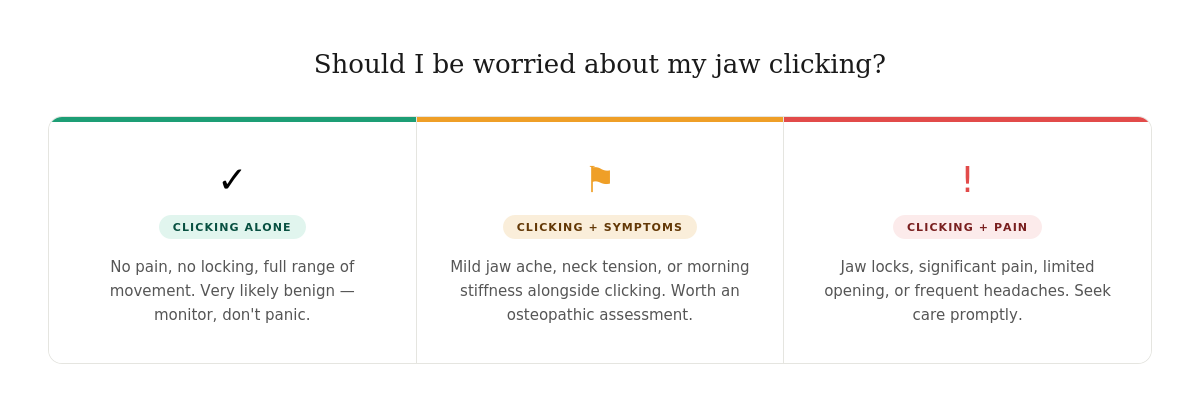
The click isn't the problem - context is
Research published in the Royal Australian College of General Practitioners journal confirms that while signs of TMJ disorder appear in up to 60–70% of the population, symptomatic disease requiring treatment occurs in only 5–12%. What matters is what accompanies the sound.
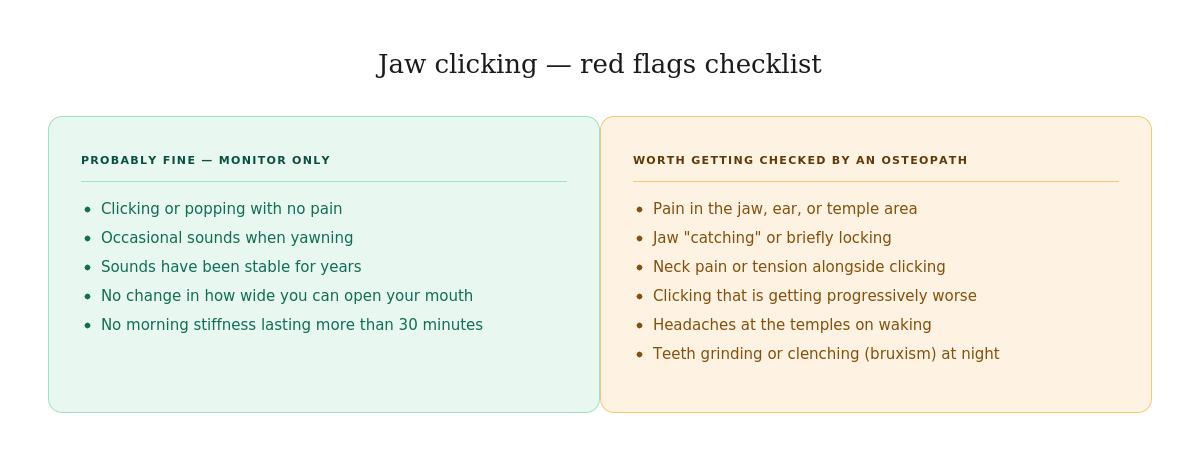
The red flags to know
Not all jaw sounds are created equal. Use this as your quick self-check:
One to remember: Despite how common jaw sounds are in Australia, only about 1 in 4 people with signs is even aware they have a TMJ issue - and a fraction of those ever seek care. If you're experiencing pain or locking alongside the click, you're not being dramatic. Early assessment leads to better outcomes.
What's actually causing it?
Disc displacement - The most common cause. The articular disc slips slightly forward of the condyle and snaps back with movement. Often completely harmless when pain-free.
Muscle tension and imbalance - From an osteopathic perspective, this is often underappreciated. Tight masseters, pterygoids or suboccipital muscles alter the mechanics of the whole joint. Postural habits, stress, and neck dysfunction all feed into this.
Bruxism (teeth grinding or clenching) - Puts chronic load on the disc and surrounding soft tissue. If you grind at night and your jaw clicks, the two are almost certainly connected. Stress and anxiety - both well-documented contributors to TMJ dysfunction - are often at the root of bruxism too.
Joint hypermobility - People with naturally lax ligaments tend to have noisier joints generally. The TMJ is no exception. Typically benign but worth monitoring.
Cervical spine involvement - The connection between the upper neck and jaw mechanics is well-established. Restricted movement at C1 and C2 can influence how the jaw tracks, sometimes contributing to clicking and muscle guarding around the joint - which is why TMJ symptoms often respond well to treatment that isn't directly focused on the jaw itself.
Where osteopathy fits in
Most jaw clicking doesn't need to be "fixed" — but when it does become a problem, osteopathic treatment addresses the whole picture rather than the joint in isolation. That typically means working on the soft tissue around the jaw itself, releasing tension in the neck and upper thoracic spine, and looking at how posture, breathing patterns, and stress are loading the system.
Patients are often surprised that their jaw symptoms improve significantly after work that seems entirely focused on their neck or shoulders. That's not coincidental — the jaw, skull, and cervical spine are functionally inseparable, and treating them as a connected system tends to produce much better results than treating the joint alone.
The bottom line
Jaw clicking is one of the most common musculoskeletal findings in the Australian population — and for the majority of people, it's nothing to worry about. Jaw clicking with pain, locking, headaches, or neck tension is a different conversation, and one worth having with a practitioner who understands how the whole system works together.
Not sure where you sit?
Book a jaw assessment
and get a clear answer
A single osteopathic consultation can tell you whether your jaw
clicking is something to monitor or something to address - and
give you a plan either way. No referral needed.
Most TMJ concerns are resolved in 1–3 sessions
Whole-body assessment - No referral required - Neck & jaw treated together
Sources: Royal Australian College of General Practitioners (2018); Australian Dental Journal; National Survey of Adult Oral Health 2004–06; BMC Oral Health (2021).
This post is for general information only and does not constitute clinical advice. If you are experiencing jaw pain, restricted movement, or other symptoms, please consult a qualified healthcare professional.